🟢 EASY
💰 Quick Win
Process Analyzer
Why Process Documentation Is the Competitive Edge You’re Missing
⏱️ 8 min read
“Look, I’ve seen businesses rise and fall faster than a market crash, and often, the silent killer wasn’t competition or bad luck. It was chaos. An invisible, insidious force stemming from the lack of clear instructions, the ‘tribal knowledge’ held by one key person, or processes existing only in someone’s head. I once witnessed a scaling startup almost implode because their sales onboarding process was an oral tradition passed down by a single, overworked veteran. When he took a two-week vacation, the entire sales pipeline choked. That’s why I’m telling you:
process documentation isn’t just a bureaucratic chore; it’s your operational blueprint, your survival guide in the wild west of scaling. In 2026, with AI accelerating everything, if you’re not documenting your processes, you’re not just falling behind – you’re digging your own grave.”
The Unseen Enemy: Why Process Documentation is Your First Line of Defense
The Cost of Chaos: Invisible Drain on Resources
“I’ve sat in too many war rooms where the battle wasn’t against a competitor, but against internal inefficiency. Studies consistently show that companies lose between 20-30% of their revenue annually due to inefficiency. Think about that – nearly a third of your hard-earned cash just evaporating because nobody wrote down how things are *supposed* to work. You’re paying people to reinvent the wheel, to chase down answers, to fix avoidable mistakes. This isn’t just about lost money; it’s about lost time, lost morale, and ultimately, lost potential. Process documentation is the antidote to this chaos, a critical step towards operational excellence.”
Beyond Compliance: Building a Resilient Business
“Sure, auditors love a well-documented process. It keeps the regulators happy and demonstrates your commitment to quality (ISO 9001, anyone?). But let’s be real: compliance is the bare minimum. The real power of process documentation lies in building a truly resilient business. Imagine a scenario where a key employee leaves. If their critical functions are documented, you don’t skip a beat. If a new market opportunity arises, well-defined processes mean you can pivot and scale faster. It’s about preparedness, adaptability, and ensuring your business can weather any storm, not just tick boxes.”
Defining Your Battlefield: What Exactly Are We Documenting?
From Vision to Granularity: Tiers of Documentation
“You don’t just start writing everything down. That’s like sending your troops blindly into battle without knowing the terrain. You need a strategy. We typically break documentation down into tiers. At the highest level, you have your strategic processes – how you onboard a customer, develop a product, or handle support. Then, you drill down into specific departmental processes, and finally, task-level instructions – the nitty-gritty ‘how-to’ guides. Think of it like a military strategy: grand objective, campaign plans, then individual mission briefings. Start high, then go deeper where the bottlenecks and risks are.”
Identifying Critical Workflows: Where to Start the Fight
“Where do you begin? Not everywhere at once. Focus your initial efforts on the critical paths – the processes that directly impact revenue, customer satisfaction, compliance, or carry high risk. Ask yourselves: ‘What processes cause us the most pain? Where do we consistently make mistakes? What’s holding up our growth?’ Often, these are your customer onboarding, sales pipeline management, core product delivery, or financial reconciliation processes. Prioritize. Attack the biggest problems first. That’s where you’ll see the fastest return on your documentation investment.”
The War Chest: Essential Tools and Methodologies
BPMN and Flowcharts: Your Tactical Maps
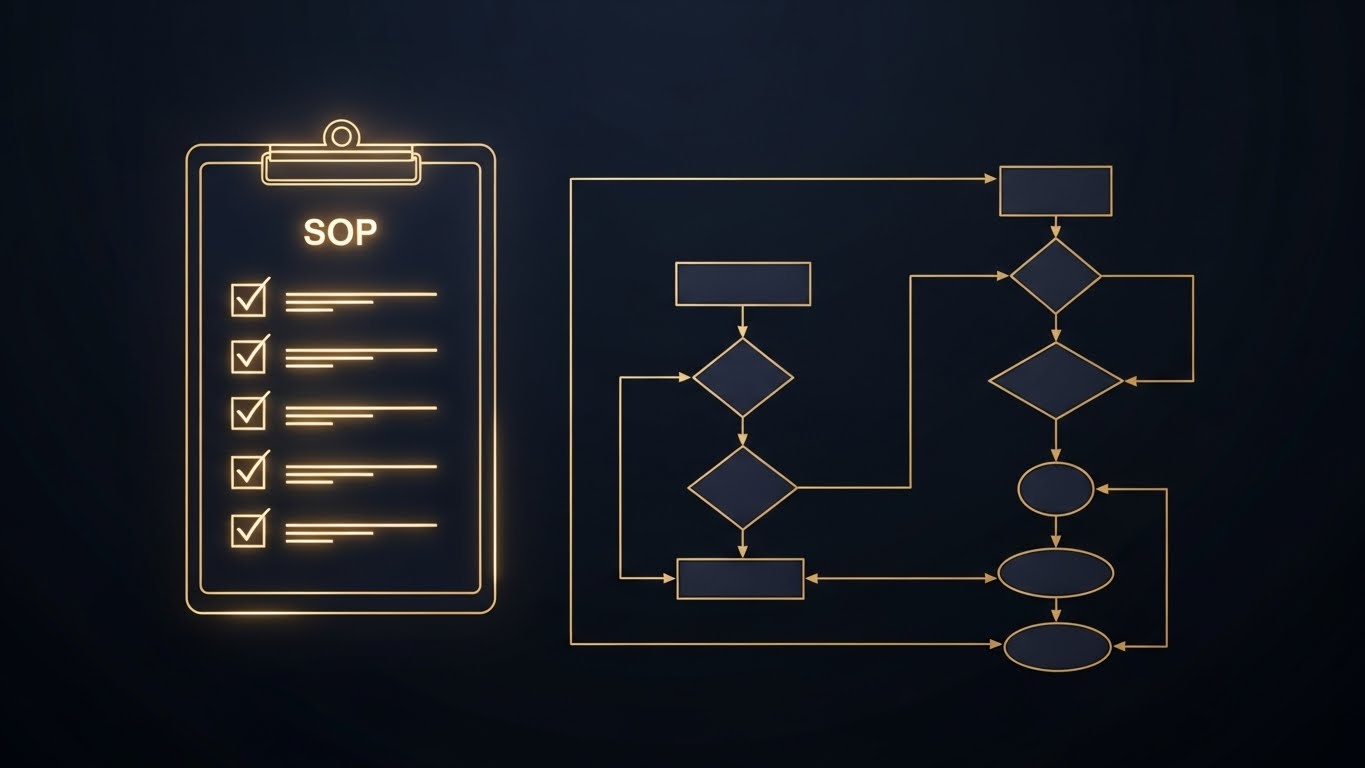
“In the old days, it was sticky notes and whiteboards. Now, we have powerful tools. Business Process Model and Notation (BPMN) is your universal language for mapping processes. It’s not just a pretty diagram; it’s a standard that allows anyone, from a tech lead to a marketing manager, to understand how a process flows, where decisions are made, and who is responsible. For simpler tasks, a basic flowchart can still be incredibly effective. The key is visual clarity. A picture truly is worth a thousand words, especially when those words are trying to describe a complex sequence of actions.”
AI-Powered Documentation: The New Reconnaissance
“This is where 2026 changes the game. Forget manually observing every step; AI is your scout. Tools powered by process mining and task mining leverage machine learning to observe user interactions and system logs, automatically discovering and mapping processes as they actually happen. S.C.A.L.A. AI OS, for example, can analyze your operational data to identify common workflows, redundant steps, and potential automation opportunities. This reduces the manual effort of documentation by 40-60%, making it faster, more accurate, and less prone to human bias or oversight. It’s like having an always-on observer, detailing every move your troops make on the battlefield.”
The Art of War: Crafting Effective Process Documents
Clarity and Conciseness: No Room for Ambiguity
“A badly written process document is worse than no document at all – it creates confusion, not clarity. Your documents must be clear, concise, and unambiguous. Use simple language, avoid jargon where possible, and break down complex steps into manageable chunks. Imagine you’re writing instructions for someone who has never done this task before. What do they need to know? What are the common pitfalls? Every sentence should add value. If it doesn’t, cut it. This isn’t a novel; it’s a field guide.”
Visual Aids and Templates: Speaking a Universal Language
“Humans are visual creatures. Integrate screenshots, diagrams, and video tutorials. A short, 30-second video demonstrating a software function can save hours of reading. Develop standard templates for different types of processes (SOPs, checklists, policies) to ensure consistency and ease of use. This standardization reduces the cognitive load on your team and makes the documentation itself a more approachable resource, rather than a dense, intimidating manual.”
Building Your Elite Squad: Who Owns the Documentation?
Distributed Ownership: Every Soldier a Scribe
“You can’t dump this all on one person. That’s a recipe for burnout and outdated information. The best approach I’ve seen is distributed ownership. The people who *do* the work are the best people to document it. Empower your teams. Give them the tools, the templates, and the training. Make it part of their ongoing responsibilities, not an ‘extra’ task. This fosters a sense of ownership and ensures the documentation reflects the reality on the ground, not just some theoretical ideal.”
The Role of the Process Champion: Your General on the Ground
“While ownership is distributed, you still need leadership. Designate process champions within each department or for key cross-functional processes. These are the individuals responsible for overseeing the quality, consistency, and regular review of the documentation within their domain. They act as the central point of contact, ensuring alignment with overall business objectives and facilitating communication between teams. Think of them as your platoon leaders, ensuring their squad’s tactical maps are always up-to-date and accurate.”
The Battlefield of Onboarding: Cutting Training Time and Costs
Accelerated Ramping: From Months to Weeks
“One of the most immediate ROI areas for process documentation is onboarding. Without it, new hires are left floundering, asking the same questions repeatedly, and relying on overburdened colleagues. With comprehensive documentation, you can slash onboarding time dramatically. I’ve seen companies reduce time-to-productivity for new hires by 50-70%, from three months down to three weeks, simply by providing clear, accessible SOPs. This isn’t just about saving HR time; it means new team members contribute sooner, impacting your bottom line faster.”
Reducing Human Error: The Price of Ignorance
“Every mistake costs money – rework, customer dissatisfaction, compliance fines. Undocumented processes are breeding grounds for errors. When steps are clear, sequential, and checked, the likelihood of human error plummets. It’s like giving pilots a detailed flight checklist; you don’t want them improvising during takeoff. In highly regulated industries, this isn’t just good practice; it’s essential for survival. Clear processes reduce errors by up to 80% in some cases, safeguarding your reputation and your revenue.”
Unlocking the Power of Automation: AI’s Role in 2026
Automated Discovery and Mapping: AI as Your Scout
“As I mentioned, AI isn’t just a buzzword; it’s a force multiplier for process documentation. Beyond discovery, advanced AI platforms can analyze vast datasets to identify process variations, compliance gaps, and even predict potential bottlenecks before they occur. This predictive capability allows you to be proactive, optimizing processes based on data, not just anecdotes. It transforms documentation from a static record into a dynamic, intelligent system that informs your strategy.”
RPA and Smart Workflows: Executing with Precision
“Once your processes are documented and optimized, the next logical step is automation. Robotic Process Automation (RPA) and intelligent workflow automation tools can take those clearly defined steps and execute them autonomously. AI helps identify which processes are prime candidates for automation, offering insights into potential efficiency gains – often 25-50% time savings for repetitive tasks. This frees up your human talent for more strategic, creative, and customer-facing work, essentially putting your best soldiers on the highest-value missions.”
Compliance and Risk Management: Navigating the Minefield
Meeting Regulatory Demands: Avoiding Legal Landmines
“The regulatory landscape is only getting more complex. GDPR, HIPAA,
Start Free with S.C.A.L.A.